
5 Powerful AI Research Tools
AI has quickly become an essential companion for researchers around the world. Whether you’re in a university lab, a startup, or a corporate Research and Development team, it’s changing how research actually gets done—from planning and analysis to writing and publishing. As per a report in 2025, about 75- 80 % of professionals are already using AI in some way, and about 20-25% rely on it to make their daily work faster and smoother. What’s really interesting is how far it’s come—AI isn’t just handling repetitive tasks anymore, It can analyze complex information, help draft content, and even give insights that point toward likely research outcomes.
The biggest benefit of AI in research is its speed and accuracy. The AI tools can handle massive amounts of data within fraction of seconds that could easily take from several days to weeks for a human. These tools saves time, reduces mistakes, and allows researchers to focus on deep analysis rather than just the routine data tasks.
1. Semantic Scholar – Smarter Academic Search
If you’ve ever searched for research papers on Google and felt overwhelmed, Semantic Scholar is a great alternative.
Built with AI at its core, it doesn’t just list papers — it helps you understand which ones matter you the most.
Why people use it?
- Highlights key points from research papers
- Shows citation influence and relevance
- Filters out less impactful results
- Covers millions of academic publications
Best for:
Students and researchers looking for high-quality, relevant papers quickly.
💡 Example:
Instead of opening 20 papers, you can identify the most important ones in minutes.
2. Elicit – Research Assistant for Literature Review
Doing a literature review can be exhaustive. That’s where Elicit comes in real handy.
It acts like a research assistant that can find papers, extract key insights, and even compare results across studies.
Why it stands out:
- Answers research questions using papers
- Extracts summaries automatically
- Compares multiple studies side by side
- Saves hours during literature reviews
Best for:
Academic researchers, thesis writers, and analysts.
💡 Example:
Ask a question like “What are the effects of remote work on productivity?” and get structured answers backed by research.
3. Scite – Smart Citations You Can Trust
Citations are not all equal — some support a claim, others contradict it.
Scite helps you understand the difference.
Why it’s powerful:
- Shows whether a paper supports or disputes a claim
- Provides context for citations
- Helps verify research credibility
- Improves quality of academic writing
Best for:
Researchers and professionals who need reliable, evidence-based insights.
💡 Example:
Before citing a paper, you can check if it’s actually supporting your argument.
4. Research Rabbit – Discover Papers Visually
Sometimes research isn’t about searching — it’s about discovering connections.
That’s where Research Rabbit shines.
It creates visual maps of research papers, helping you explore related work in a more intuitive way.
Why people love it?
- Visualizes research connections
- Recommends papers based on your interests
- Tracks authors and trends
- Makes discovery feel natural
Best for:
Exploratory research and finding hidden connections between topics.
💡 Example:
Start with one paper and uncover an entire network of related studies.
5. NotebookLM – Your Personal AI Research Notebook
When it comes to working with your own research material, NotebookLM stands out in a way most AI tools don’t.
Instead of pulling information from across the internet, it focuses on the sources you provide. You can upload research papers, PDFs, notes, or even links — and it builds its responses around that content.
Why it stands out:
- Works directly with your uploaded research material
- Provides answers with source-based references
- Summarizes and explains complex documents
- Helps connect ideas across multiple files
Best for:
Students, researchers, and professionals who are working with multiple documents and want reliable, source-grounded insights.
💡 Example:
Upload a few research papers and ask, “What are the key differences between these studies?” — and get a clear, structured answer based only on your sources.
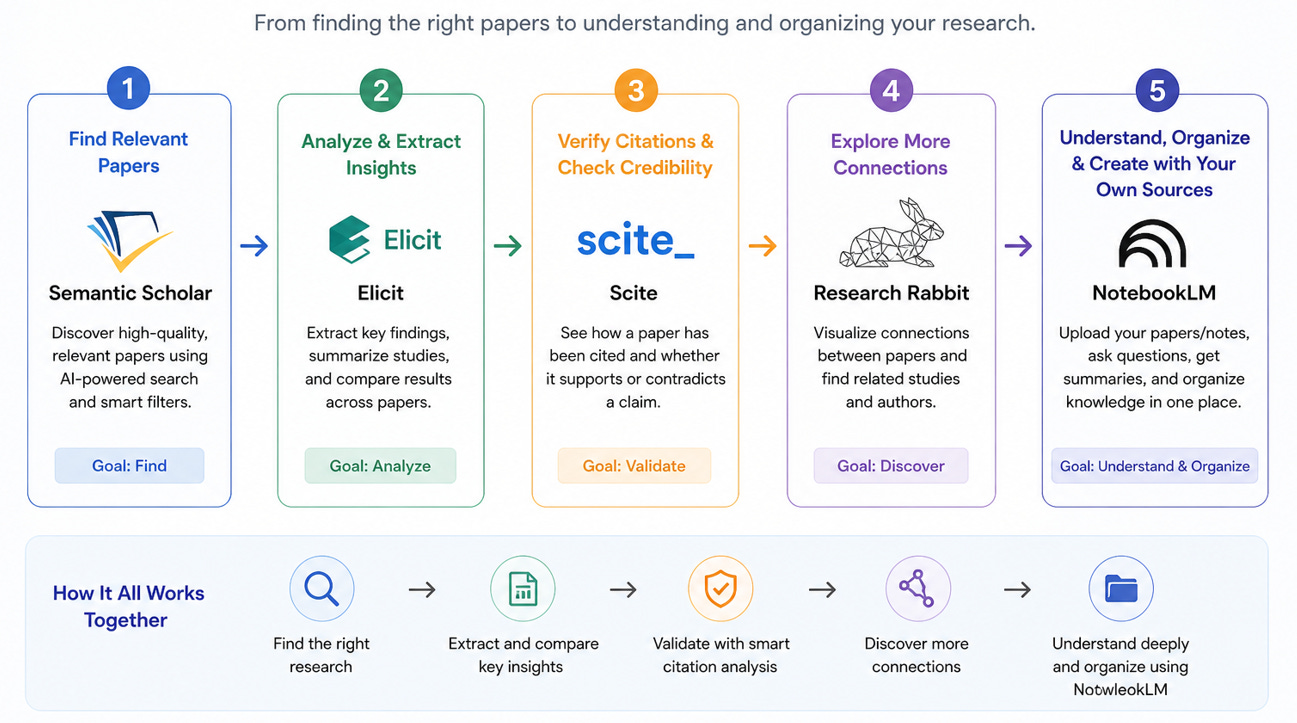
A Simple Research Workflow using 5 AI tools:
Final Conclusion
AI research tools are not replacing traditional research methods — they’re enhancing them. Instead of spending most of your time searching and organizing, you can now focus on:
- Understanding concepts
- Connecting ideas
- Producing meaningful insights
One thought on “5 Powerful AI Research Tools”
Leave a Reply

Related Posts

Good blog, great summary. This list would be really helpful for anyone.